

Most people hear “concrete art” and picture cold parking garages or brutalist buildings. Hard pass. But that assumption is exactly what’s holding a lot of homeowners and business owners back from one of the smartest, most versatile design choices available today.
Concrete art, in the design sense, is where raw material meets intentional craft. It’s functional. It’s one-of-a-kind. And when done right, it genuinely stops people in their tracks.
Here’s what we’re covering:
- What concrete art actually is (and what it’s not)
- The different forms it takes, from countertops to custom flooring
- Why it holds up better than most traditional materials
- How the design process works, start to finish
- How to tell the difference between quality concrete artistry and work that won’t last five years
That last point is something most articles skip entirely. We’re not going to.
If you’re in South Florida and want to see what this looks like in practice, the team at Koncrete Art has been doing this for over a decade. We’ve built everything from custom concrete sinks to full commercial flooring installs across Miami, Fort Lauderdale, and beyond.
So, What Is Concrete Art?
Concrete art, in the design world, is the practice of using concrete not just as a building material, but as a creative medium. Think handcrafted countertops, sculptural sinks, polished floors, and custom fire pits, all made with intention and artistic precision.
It sits right at the intersection of function and form. You get something that works every single day and looks like it belongs in an architectural magazine.
Not Your Average Slab of Concrete
Most people’s first mental image of concrete is a sidewalk or a parking structure. Concrete art is the complete opposite. Here’s what separates it:
| Standard Concrete | Concrete Art |
|---|---|
| Mass-produced, uniform | Handcrafted, one-of-a-kind |
| Purely structural | Functional and decorative |
| No color or texture variation | Fully customizable finish, color, and form |
| Generic look | Tailored to your vision |
What Can Be Made With It?
Pretty much anything you can imagine for a home or commercial space:
- Countertops and sinks for kitchens and bathrooms
- Polished flooring for residential and commercial spaces
- Fire pits, benches, and outdoor features
- Custom furniture and statement pieces
The material itself is incredibly versatile. It can be molded into virtually any shape, stained in dozens of colors, and finished anywhere from raw and industrial to smooth and glass-like. That flexibility is exactly what makes it so popular in modern interior design.
The Many Forms Concrete Art Takes
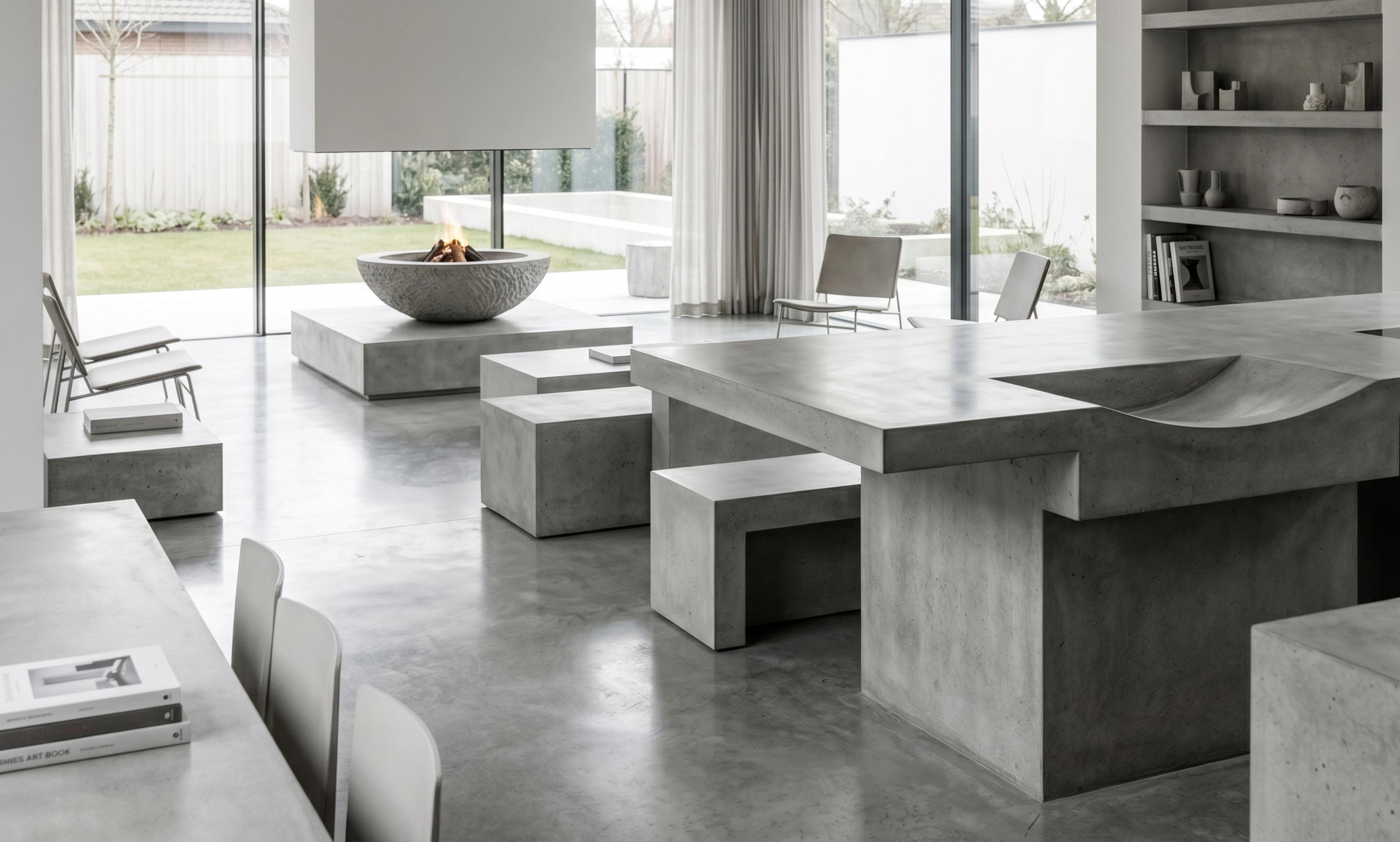
Concrete art, as a design medium, is one of the most versatile materials in existence. Unlike natural stone that’s cut from the earth in fixed slabs, concrete starts as a fluid. It gets poured into a mold. That means it can take on any shape, color, texture, or dimension you want.
Think of a canvas before a painting exists. Blank. Full of possibility. That’s what raw concrete is before a skilled artist gets to work.
Where You’ll See It in Homes and Businesses
The applications are broader than most people expect. Here’s a quick breakdown:
| Application | Common Spaces | Finish Options |
|---|---|---|
| Countertops | Kitchens, bathrooms, bars | Polished, honed, raw, pigmented |
| Flooring | Living rooms, offices, retail | Polished, stained, sealed |
| Sinks | Bathrooms, outdoor kitchens | Custom-molded, integrated drain |
| Tables | Dining, outdoor, commercial | Any shape, any color |
| Fire pits | Patios, poolside areas | Textured, stained, sealed |
| Benches | Gardens, entryways, lobbies | Smooth, exposed aggregate |
| Showers | Master baths, spa spaces | Seamless, waterproofed |
Each piece starts in the mind, much like the early concrete art movement’s manifesto insisted: the work must be entirely conceived before it’s executed. The distinction here is that our version has a strong emphasis on livable, functional art rather than purely abstract expression.
The color palette alone is essentially unlimited. Pigments get mixed directly into the concrete, and stains or dyes can be layered after curing to create everything from soft, earthy tones to bold, dramatic hues. Glass, stone, or metal inlays are also embedded into the surface for added visual interest, and different finishes can shift the entire feel of a piece from industrial-raw to polished-luxury.
Pro tip:The finish you choose affects maintenance as much as aesthetics. A polished, sealed surface is far easier to clean than a raw, unsealed one. Always ask your contractor about long-term upkeep before finalizing a finish style.
Why Concrete Outlasts Most Traditional Materials
Here’s a belief worth challenging: Granite is more durable than concrete. It’s popular, but it’s not quite the full picture.
Properly crafted and sealed concrete is both scratch-resistant and heat-resistant. It doesn’t chip the way marble does. It won’t stain the way unsealed granite can. And unlike quartz, which is manufactured with synthetic resins, concrete is a completely natural mix of materials, free from artificial binders that can degrade over time.
Concrete vs. The Competition
| Material | Durability | Customization | Maintenance |
|---|---|---|---|
| Concrete | Very high when sealed | Unlimited | Annual resealing |
| Granite | High | Limited (natural only) | Periodic resealing |
| Marble | Moderate (chips, stains) | Low | Frequent resealing |
| Quartz | High | Moderate (engineered) | Low |
| Laminate | Low | Low | Easy |
Concrete also develops a natural patina over time. Some people see that as a flaw. Most concrete art owners see it as character. The surface ages with the space, rather than against it.
For flooring, the gap is even wider. Polished concrete floors can last decades with minimal upkeep, which is exactly why so many businesses are moving toward them. One client noted her polished concrete floor actually lowered the temperature of her home, something no tile or hardwood can claim. You can read more about extending the life of polished concrete floors to get a clearer picture of what long-term care actually looks like.
The real secret to durability, though, isn’t the material itself. It’s the quality of the mix, the craftsmanship in the pour, and the sealing process. Which brings us to the next point.
How the Design Process Works
A lot of people assume you just pick a style and someone shows up to pour concrete. The actual process is more collaborative than that, and understanding it helps you get a result you’ll love for years.
Here’s how it typically flows when working with a team like ours at Koncrete Art:
- Consultation: You share your vision, space dimensions, and budget. The goal is to understand not just what you want it to look like, but how it’ll be used day-to-day.
- Design selection: Color, texture, finish, edge profile, and any special features (like integrated sinks, embedded inlays, or custom shapes) get finalized here.
- Mold creation: A custom mold is built to your exact specifications. This is where precision matters most. Every line, every curve, every plane gets organized before a drop of concrete is mixed.
- Fabrication: The concrete is mixed, poured, and carefully cured. Pigments and aggregates are added during this stage. Curing time varies by project, but it’s non-negotiable. Rushing it compromises everything.
- Finishing and sealing: Once cured, the surface gets ground, polished, or textured depending on the chosen style, then sealed for protection.
- Installation: The finished piece gets transported and installed with care. For larger builds like custom concrete sinks or full commercial flooring, this can involve a full crew.
The timeline from consultation to install typically runs a few weeks. It’s not an overnight process, and it shouldn’t be. Good concrete art is created, not rushed.
Quality Concrete Art vs. Work That Won’t Last
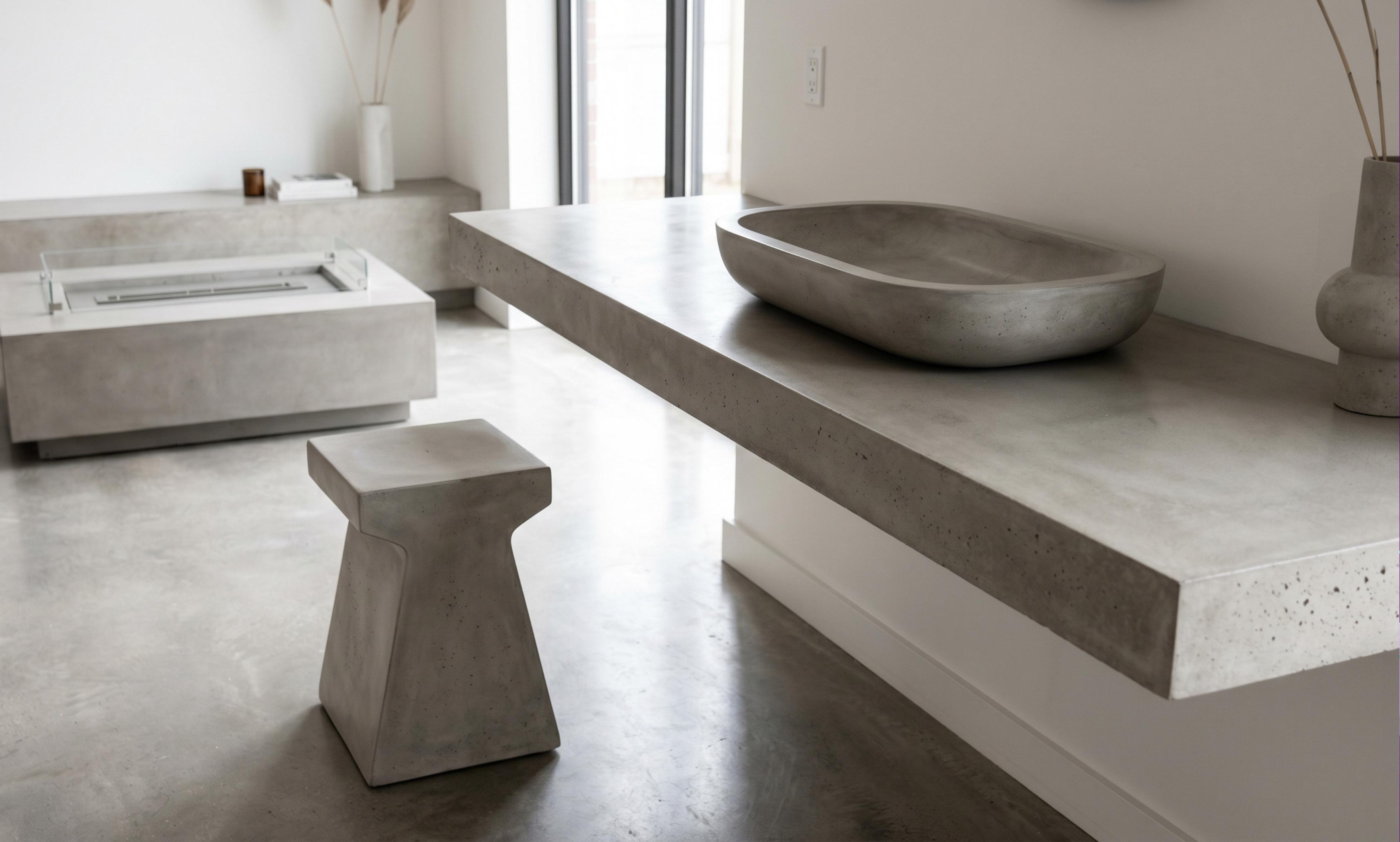
This is the section most people wish they’d read before hiring the wrong contractor. Not all concrete work is equal. Far from it.
Poor craftsmanship doesn’t always show up immediately. Sometimes it takes 12 to 18 months before the problems become obvious, by which point it’s expensive to fix.
Red Flags in the Work Itself
Watch for these signs that the concrete was done poorly:
- Spider-web cracking: A few hairline cracks are normal. Networked cracking spreading across a surface means the mix ratio was off or curing was rushed.
- Scaling or flaking: The surface layer peeling away is a sign that the concrete wasn’t cured correctly or the mix was too watery.
- Uneven coloring: Blotchy, inconsistent pigment is a symptom of poor mixing. In quality work, color is uniform and intentional throughout.
- Honeycombing: Visible air pockets or voids on the surface mean the concrete wasn’t properly compacted during the pour.
- Rough finish where smooth was promised: Trowel marks and uneven texture in a surface advertised as polished is a clear sign of rushed finishing.
Red Flags in the Contractor
The work reflects the person doing it. A few things to vet before you commit:
- No portfolio of completed projects: Concrete art is visual. If they can’t show you their work, walk away.
- Vague on process: A skilled craftsperson can walk you through every step. Vagueness about mix ratios, curing time, or sealing is a warning sign.
- No mention of sealing: An unsealed concrete surface is a liability. Any contractor worth hiring will include sealing as a standard part of the job.
- Unusually fast timelines: If someone promises a full concrete countertop installation in two or three days flat, that’s a red flag. Proper curing alone takes several days minimum.
Quality work, on the other hand, has a consistency you can see and feel. Uniform color. Crisp edges. Smooth, sealed surfaces. Zero honeycombing. And a contractor who can explain exactly what they did and why.
We’ve been doing this across South Florida for over a decade, from Fort Lauderdale to Miami to Boca Raton. Every piece we produce goes through the full process, no shortcuts, because the goal is always to work that looks as good in ten years as it does on install day. You can see what that actually looks like in our portfolio.
Where the Idea of Concrete Art Came From
Most people don’t realize the phrase “concrete art” has roots that go back nearly a century. And understanding where it came from actually changes how you see the design choices being made today.
It started with a very specific issue in the art world.
By the late 1920s, abstract art had developed a tendency toward cold abstraction: work that was geometric in form but felt accidental in spirit. Sculpture, concrete painting, and artworks across Europe were drifting into what critics called programmatic art, ideas so rigid they drained the life out of creation itself.
Dutch artist Theo van Doesburg had seen enough.
The Manifesto That Started It All
In 1930, van Doesburg published the Basis of Concrete Art in France. It was a manifesto intended to introduce a hard distinction between his vision and the rest of the abstract art world. The core ideas he signed onto were direct:
- Art must be entirely conceived in the mind before execution
- Work must exclude lyricism, symbolism, and sensuality
- The canvas must receive nothing from the natural world
- Pure planes, pure line, pure color only
- Creation must be real, not borrowed from nature
The consequence was a completely new design language. One built on universal geometric abstraction, free from emotion and decoration.
How the Movement Grew
Van Doesburg didn’t work alone. A group of artists and members from across Europe developed these ideas further. Jean Hélion was among those who signed onto the movement early. Swiss artist Max Bill became its most recognized champion, organizing the first international exhibition of concrete art in Zurich, Switzerland, in 1944.
| Key Figure | Role | Country |
|---|---|---|
| Theo van Doesburg | Published original manifesto | France / Netherlands |
| Max Bill | Organized first international exhibition | Switzerland / Zurich |
| Jean Hélion | Early group member | France |
From there, the movement was promoted across Europe and Latin America. The Getty Conservation Institute has since studied artworks from this period as part of preserving major 20th-century collections.
Today, several museum collections across Switzerland and beyond house pieces from this development, a testament to how far the concrete art movement’s reach extended from its origins in schools of geometric abstraction.
What This Abstract Art Has to Do With Your Home
Here’s the real point. The same philosophy introduced by this movement, intention over accident, material honesty, form organized with purpose, is exactly what separates handcrafted concrete design from a factory floor or a generic countertop slab.
Every piece we create starts the way van Doesburg described: conceived entirely in the mind first. Every color decision, every texture, every geometric line is deliberate. No shortcuts. No decoration for decoration’s sake.
That’s not a coincidence. It’s a consequence of working in a medium with a strong emphasis on craft and creation at its very core. The concrete art movement popularized a universal design language, and its ideas are still being expressed today, just in custom countertops, sculptural sinks, and polished floors instead of a museum canvas.
Your Space Deserves Real Concrete Art. We Make It.
Concrete art isn’t just a design trend. It’s a centuries-old philosophy of intentional creation, brought to life through material, skill, and a clear vision. Whether it lives on your kitchen counter, your bathroom floor, or your backyard patio, the right piece transforms a space permanently.
Key takeaways:
- Concrete art combines function and artistic intent, it’s not just a building material
- It’s fully customizable in color, shape, texture, and finish
- Properly sealed concrete outlasts marble, resists heat, and develops character over time
- The design process is collaborative and takes weeks, not days
- Poor craftsmanship shows up as cracking, scaling, uneven color, and honeycombing
- The concrete art movement’s core idea, conceived in the mind first, still drives quality work today
Concrete Art Design has spent over a decade turning exactly that philosophy into custom pieces across South Florida. From polished floors in Fort Lauderdale to handcrafted sinks in Miami, every project starts with your vision and ends with something genuinely one-of-a-kind. Reach out to our team whenever you’re ready.
Frequently Asked Questions
What Is the Meaning Behind Concrete Art?
Concrete art means pure creation from the mind, using line, color, and planes with no symbolism, lyricism, or references to the natural world.
Is There a Market for Concrete Art?
Yes. Demand for custom concrete design in homes and commercial spaces is growing rapidly, especially for countertops, flooring, sinks, and outdoor features.
What Is the Difference Between Concrete Art and Abstract Art?
Abstract art draws from emotion or nature. Concrete art is entirely self-referential, free from symbolism, sensuality, or any external influence whatsoever.
How Do You Paint So It Looks Like Concrete?
Use layered gray tones, a sponge texture technique, and a matte sealer. Professional concrete finishes, however, always outperform painted imitations.
What Is Concrete Art Called?
It’s also called geometric abstraction or Konkrete Kunst in German. In design contexts, it’s referred to as decorative or custom concrete design.
Who Was the Artist Known for Concrete Sculptures?
Max Bill, the Swiss artist who organized the first international exhibition in Zurich, is most closely associated with concrete sculpture and the broader movement.


